Showing posts with label NHL. Show all posts

Monday, May 30, 2011

Where is the love for hockey?

Each spring, both the NBA and NHL maintain roughly the same playoff schedules, starting in April and ending in June. Basketball appeals to a much bigger audience (and hence, better ratings). But, what is it about hockey that makes it the red-headed stepchild of major sports? Let's examine this in greater detail.

1. Hockey lacks well-known personalities. The game's best players are arguably Sidney Crosby and Alexander Ovechkin. Crosby is, by many accounts, a very sheltered individual. The only thing we know about him personally is that he lived in Mario Lemieux's (Penguins owner and Hall of Fame player) basement. Other than that, we know he really likes to play hockey. His interviews are frankly quite bland. Ovechkin offers a glimmer of personality. The Russian-born player with his jack-o-lantern smile has done some commercial spots that are fairly amusing, but many consider him to be a dirty player. The skill that these two possess is not being questioned. As faces of their sport, they need to generate interest in hockey. While their stellar play may motivate people to watch or play hockey, the lack of personality doesn't add to the intrigue of the NHL.


One of the faces of the NHL?  How recognizable are hockey stars to the casual fan?


Look at other sports. There are glamour names, for better and worse, where we feel that we know a lot about the superstars. In baseball, you've got Derek Jeter - playboy, but generally a good guy - and Alex Rodriguez - narcissistic, huge ego, dates celebrities. Basketball - there's LeBron James - his infamous "The Decision" - and Kobe Bryant - adulterer turned devoted family man (at least that's how he's selling it). In football, Tom Brady - enjoying being Mr. Gisele Bundchen and the modeling life - and Brett Favre - folksy southerner who can't make up his mind on retirement and sends graphic texts to co-workers. Maybe some of these guys aren't the game's best players, but they're certainly among the elite. Can you name one true national or international personality in the sport of hockey? I can't. FYI - Sean Avery doesn't count - he's just a prankster who never grew up.


Whether you like him or not, I'm pretty sure any sports fan knows who this guy is.

2. Media coverage is pathetic. It really bothered me that the NHL signed a deal to continue being shown on NBC and the Versus networks through the 2021 season. Sure, the NHL grabbed the best deal possible, but the combination of these networks are making a lackluster effort to market the game. It's tough when NBC shows 13 games a year, and calls that "coverage." Versus at least offered 78 televised contests this past season, but can you even find the network on your cable or satellite provider? If I found it, I'd have to spend $5 more per month to watch games. No thanks. Increase the schedule to 150 games with a nightly telecast and you might have a buyer. Instead, keep going with the always exhilerating bullriding. The new contract allows for 90 games on Versus. At that rate, you might be able to see your favorite team six or seven games.

The NHL would have been better off to allow ESPN, Turner, or Fox (all potential bidders) to take the bid. I don't know about you, but when I can't find somethinig decent on television, I find a basketball game - usually college, but occasionally the pros - to watch. Think of all the casual observers that Turner and ESPN bring in because this country is filled with sports enthusiasts and looking for something entertaining to watch. The NBA showed 140 games on channels that are in your regular cable lineup, with an additional 96 contests on NBA TV. You'd be able to watch your favorite team upwards of 15 times.


Wow, that is a sight for sore eyes.  I miss the nightly recaps of hockey games.  Perhaps I should move to Canada.

2. (b) Sportscenter. ESPN only carries hockey stories if it is an absolute necessity. I find this to be despicable. From May 17 through May 21, I calculated the air time that was provided to basketball and hockey on ESPN's signature show. The study found an average of 17 minutes and 30 seconds was devoted to the NBA (about 40% of the show). How much time did they specifically devote to the NHL Conference Finals this week? A measley 3 minutes and 5 seconds per show (7%). Disgusting. And, if you listen to other national podcasts (like Mike & Mike), you won't hear a peep about the NHL. Like it or not, hockey is one of our major sports. Let's give it a little more attention.

Maybe the network doesn't want to roll out Barry Melrose every time hockey needs to be discussed. That's understandable. ESPN allows Magic Johnson to speak on a regular basis to share his viewpoint on the NBA. I know for certain that ESPN could employ someone (frankly anyone) to speak more intelligently about hockey than Johnson does about hoops. For instance, John Buccigross offers an exceptional hockey mind to the network.

3. Poor market choices. Our friends north of the border may have invented the game, but how many franchises still reside in Canada? Five - Calgary, Edmonton, Montreal, Toronto, Vancouver. Truth be told, the reason hockey migrated south each winter leaving franchises like Winnipeg and Quebec, was for the 'Benjamins,' not the loonies. The American economy has been in the toilet for the better part of a decade now, yet the public still clamors for entertainment, attending hockey games throughout the country, even in smaller markets (Minnesota, Pittsburgh, and Buffalo have fantastic fans). There are, however, some franchises that are suffering through poor management and poor attendance. Hockey is like religion throughout Canada - imagine the passion that true hockey fans can bring to the game. Why not re-discover rabid fanbases to spark interest in the game? Are you telling me that Phoenix (71% attendance in 2010-11) and Atlanta (73% attendance in 2010-11) have more hockey fans than Winnipeg, Hamilton, Hartford, or even Saskatoon? Just because there is a larger population doesn't always translate to interest. Rumor has it that Atlanta may relocate to Winnipeg next year. I say that's a step in the right direction. Let's relieve some of these struggling franchises and invigorate regions that want a team to follow. Each of the remaining Canadian franchises had a 100% or better average attendance this past year...just sayin'.


The crowd at the Bell Centre in Montreal is considered among the craziest in the sport.

By contrast, here's a crowd at a Phoenix Coyotes game.  Hmmm...


4. The only sport where fighting is acceptable behavior. The NHL has taken small steps towards improving the health of the game by attempting to eliminate head injuries with more severe suspensions. Intent to injure another player has no place in any sport whether it's Matt Cooke pummelling Ryan McDonagh or Andrew Bynum flattening Jose Barea. The NHL should further investigate whether fighting needs to go from a 5-minute penalty to an automatic game misconduct. I'm not one of those touchy feely people who want the elimination of all violence. As we learn from the severity of untreated concussions, it makes me wonder what a 10-plus year career as a goon may do to a person's brain. Maybe we can ask Rob Ray, Tie Domi, or Daniel Carcillo. As a youth, it was always a magical moment to witness a fight at a hockey game. Now that I'm older, I see the potential for chronic illness. Maybe we should see this disappear from the game. It would have an additional benefit to improve teams by eliminating the 'necessary' enforcer role and allowing someone with puck-handling ability or scoring touch to make the roster.  Would you rather have a guy on your team like Eric Godard, whose sole purpose is to fight or protect your star player, or Tyler Kennedy, a hard-working winger who found ways to score this year when the Penguins needed goals (when Sidney Crosby and Evgeni Malkin were injured)?

5. Leadership. Although a sport's commissioner is rarely a popular figure, Gary Bettman has been a laughingstock since he assumed the position in 1993. He has been a part of two labor stoppages, including the loss of the entire 2004-2005 NHL season. In my estimation, he is nothing more than a used car salesman. He's always looking to make the quick buck instead of improving the game. 

We are missing the boat by not getting to know more about this fantastic sport and the people who play it. Maybe if there was more exposure to hockey, personalities would emerge. The Winter Classic is a great event, but the hockey season is an 82-game grind. We should appreciate how truly skilled and tough these individuals are. The playmaking abilities including puck-handling, shot accuracy, deflections of shots is something to behold, never mind doing all of this while skating and trying to avoid crunching bodychecks from an angry defender.

Tuesday, October 12, 2010

Consol Energy Center - The Pittsburgh Penguins' New Home

 “It’s a hockey night in Pittsburgh!”  A new era of Pittsburgh Penguins hockey began on October 7, 2010 with the opening of the Consol Energy Center to NHL hockey.  Sure, Paul McCartney may have issued in the arena with a pair of concerts in August.  But, NHL hockey is why this edifice stands on 5th Avenue today.  Gone, but not forgotten is the Civic Arena (we can’t call it Mellon Arena anymore – the naming rights expired October 1st).  After all, “The Igloo” sits vacant across the street from the Penguins’ new digs.  It served as the Penguins home since franchise inception in 1967.  Forty-three years later, the building had become the oldest in the NHL.  The concourses were cramped, as were the seats.  The maintenance crew at the Igloo had a full-time job keeping the arena viable on a daily basis, especially for warm May and June playoff games.  It lagged behind other facilities in technology, amenities, training areas for the players, and money-making potential. 

The Consol Energy Center (foreground) is the new home for the Penguins.  The old home, Civic Arena (background), is just across the street.  (Michael Henninger/Post-Gazette)

How Did It Get Here?

The Pittsburgh Penguins’ road over the past decade has been a bumpy one.  Mario Lemieux was the individual who turned Pittsburgh into more than a football town as a hockey player, leading two Stanley Cup championship teams in 1991 and 1992.  After retirement, Mr. Lemieux bought the Penguins in 1999 to save the franchise from moving.  He took on terribly mismanaged financial debts from previous owners, Howard Baldwin and Morris Belzberg.  Despite trading away high-priced talent and deferring some of his own player salary (upwards of $30 million), the only option in Lemieux’s eyes to maintain hockey in the city of Pittsburgh was to get a new arena.

But, that was not forthcoming anytime soon.  The other professional sports franchises got their new stadiums using tax revenues (Pirates: PNC Park in 2001, Steelers: Heinz Field in 2001).  Of course, the tax money ran dry due to other priorities, putting the status of Pittsburgh hockey at a significant risk.  Then came the National Hockey League lockout in 2004 where no games were played.  These were some dark days in Steel City.  On top of that, the Penguins no longer were an elite team.  The team was bereft of talent despite Mario strapping the skates back on for parts of the 2000-2006 seasons.  His health simply would not permit him to play a full slate of games.  Pittsburgh wallowed in the standings, causing attendance in the middle part of the decade to plummet.

In January 2006, Lemieux stated that the team was again for sale to buyers who would keep the team in Pittsburgh.  Nine months later, it appeared that all of the problems were solved.  Jim Balsillie, a multi-millionaire from southern Ontario, had agreed to purchase the franchise.  However, rumor had it that Balsillie was going to relocate the franchise to Hamilton, a suburb of Toronto.  He rescinded his offer in December 2006, which infuriated Mario Lemieux because he violated the agreed contract.  The Isle of Capri gaming company then attempted to win the slots license, which would have allowed for development of a new arena; that fell through.  Lemieux’s beloved Penguins were once again unsettled without a future home.

Lemieux was forced to try and find a buyer…any buyer, who could take on the floundering Penguins.  He had discussions with officials in Kansas City and Las Vegas about the possibility of selling.  This move provided the necessary leverage on Pittsburgh city and Pennsylvania state officials to work out a deal.  In March 2007 (four short months before the team’s lease was due to expire), a final agreement was announced for construction of the Consol Energy Center, a multi-purpose arena.

Funding for the $321 million facility comes from three primary sources: $7.5 million per year from Rivers Casino, $7.5 million per year from the state, and $4.3 million per year from the Penguins.  The 30-year lease will keep the Penguins in Pittsburgh until 2040.

The Building Itself

The official groundbreaking for the CEC took place on August 14, 2008, with Lemieux and public officials digging their shovels into the earth.  These weren’t just ordinary shovels.  They were made from shafts of hockey sticks used by current Penguins superstar, Sidney Crosby.

The overall seating capacity is 18,087 with more than 100 standing-room tickets available.  Not coincidentally, Crosby’s jersey is 87, matching the final two digits of the number of stadium seats.  There are 66 luxury suites, which matches franchise savior Mario Lemieux’s jersey number.  Penguins spokesman Tom McMillan stated, "Mario built it, and Sid will define it.  But none of this happens without Mario."

The black and gold seats provide a striking contrast

Recent stadiums in Minnesota, Columbus, and Phoenix gave arena developers a plethora of ideas. 

The Consol Energy Center has more than 800 high-definition TVs of varying sizes throughout the arena.  The scoreboard at center-ice can show replays in HD, along with the customary scores and detailed game information.

A peek inside the oval-shaped home team's locker room

The footprint of the building is more than twice the size of its predecessor, which allowed for a top-notch training facility for both home and visiting clubs.  The workout area has the traditional weights and bikes, but also includes a hydrotherapy room, housing a pool with a submersible treadmill.  A submersible treadmill?  Yes, this would allow injured players to have low-impact workouts without risk of further injury.  Players will also enjoy enormous dressing rooms, a kitchen, lounge, and can relax with a game of bubble hockey in their down time. 

There is an abundance of food concessions inside the new facility, including a Smokehouse featuring barbecue dishes, Chef's Carvery with stir fry and pasta meals, Stack with specialty sandwiches and wraps, and Brewhouse with a wide array of alcoholic beverages. What Pittsburgh sporting arena would be complete without Primanti Bros. sandwiches? The CEC has one of those, too.

The boards have exhibited some erratic behavior in practice sessions. Some players said that the boards have dead spots, while other spots are far livelier. Pucks rimming around the end boards may accelerate. Goalie Marc-Andre Fleury said that the boards are "tough to read," comparing them to the liveliest boards in the league at Joe Louis Arena in Detroit.  Penguins players have found that the glass above the boards is pristine, providing true bounces when pucks are deflected off the glass. Players have said that the ice surface isn't the fastest yet. "It's kind of sticky, kind of slow," Chris Kunitz said. "It will be broken in, and it will be fine."

There is climate control being done through airlocks. This will make maintenance of the ice surface much easier than in the Civic Arena. Also, a reverse osmosis system is in place to treat the tap water that Zamboni drivers use to clear the ice.

The most spacious seats in the NHL are in Pittsburgh's new arena. Seats are up to 24 inches wide with ample legroom. There are nearly 2000 club seats, each of which offers a spectacular view of the ice. Also available are 236 Loge Box seats. These semi-private seats offer cushioned swivel chairs, wait service, televisions, and wireless internet capabilities.

The vantagepoint from the loge boxes

The Mario Mosaic may be the most stunning display in the new arena.  It stands in the main lobby of the CEC at 20 feet by 8 feet.  The mosaic contains over 21,000 fan and construction worker photos in a canvas that features six photographs of Lemieux as player and owner.  Those photographs featured on the mosaic were purchased to support the Mario Lemieux Foundation.  The foundation raises funds for cancer and neonatal research.

The Mario Mosaic - I highly encourage fans to visit mariomosaic.com to see the true magic of this artwork

The First Game

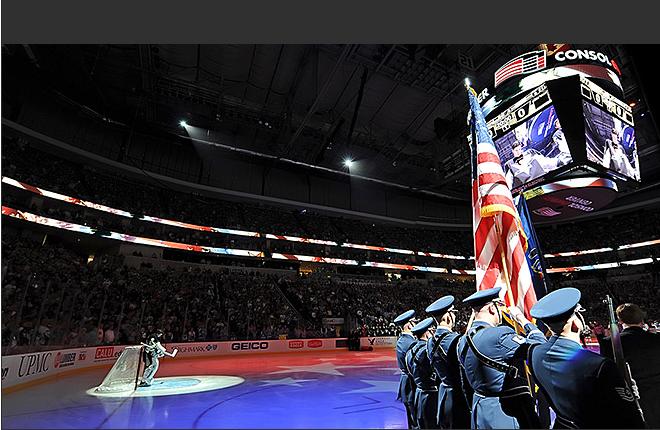
The first regular season game in the Consol Energy Center on October 7, 2010, pitted the Penguins against archrival Philadelphia Flyers.  A pre-game ceremony featured a red carpet arrival for the home team players as they entered the arena from their vehicles.  Cameras rolled, which allowed fans to watch the hoopla on an outdoor TV screen.  A scoreboard tribute was paid to John Barbero, who had been the public address announcer from 1972 to 2009.  He passed away in July due to a brain tumor.

Sidney Crosby signs an autograph as he enters the Consol Energy Center at the red carpet pre-game

The biggest flashbulb-popping moment of the night (unfortunately for Penguins fans) came during the pre-game as a solitary spotlight shone on Mario Lemieux, adorning a tuxedo and skates, poured out water melted down from the ice surface at the Civic Arena onto the new ice surface, melding together the old and new arenas.  He also dropped the ceremonial first puck moments later.

Mario Lemieux, pouring out the Civic Arena melted ice onto the surface of the CEC

Im Jimerson, a fixture at Penguins home games when it comes time for the National Anthem, sang the anthem to christen the new arena.

Marc-Andre Fleury in net, taking in the National Anthem

An above-capacity crowd of 18,289 walked through the turnstiles tonight to take in the action once all of the pre-game festivities had concluded.  This was the 167th consecutive sellout for the Penguins.

The first game was just that…a first game.  As might be expected, both teams played sloppy hockey.  The Penguins may have held the edge early in play, but didn’t take advantage of their opportunities.  Crosby hit a post that left the crowd oohing about ten minutes in, and Mike Comrie narrowly missed on a few chances in the first period.

The opening faceoff as seen from the upper level

The tide started to turn as the Flyers took advantage of costly turnovers to tilt the game in their favor.  Six short seconds after Deryk Engelland was penalized for hooking, Daniel Briere of Philadelphia netted the first goal on a deft redirection on the goal line at the 2:51 mark of the second period.  Blair Betts gave the Flyers a two-goal cushion with a rebound tap-in prior to the second intermission.

Tyler Kennedy gave the home crowd hope with a sharply angled shot that found the top of the net with 19:16 left to play.  The Flyers lead was cut to 2-1.  But, Kris Letang made a casual pass on the man-advantage inside the Penguins blue line.  Claude Giroux pounced on it for a short-handed breakaway opportunity.  He deked, causing goalie Marc-Andre Fleury to fade to his right and Giroux easily buried it in the gaping net for a 3-1 advantage.  Nineteen seconds later, newcomer Zbynek Michalek ripped a shot through traffic to notch a power-play goal and draw the Penguins to within 3-2.  The Penguins could not capitalize on a power play as time expired and dropped the first game at the new joint.

The surprise #1 star of the game was Philadelphia goalie, Sergei Bobrovsky.  Due to Michael Leighton’s injury that will keep him sidelined for a few weeks, the expected starter was veteran Brian Boucher.  Flyers coach, Peter Laviolette, went with Bobrovsky, who stopped 29 shots in his NHL debut.  The 22-year old netminder was solid and deserving of the night’s top star.

View for the Future

The Consol Energy Center is a gleaming example of perseverance by Mario Lemieux and current Penguins management.  Their efforts brought the dreams of a new arena to fruition.

I viewed the game on television and felt that the crowd was ‘flat,’ for lack of a better word.  The noise level was quieter than I would have expected.  Perhaps everyone was taking in the surroundings and not as boisterous as they could have been.  Maybe, spectators treated the arena with the respect of an art gallery or museum…afraid to be too loud or make too much of a ruckus.  Hopefully, a few games of beer spills and nacho cheese stains will let the crowd know that they can crank it up a notch.

As with the Civic Arena, the home opener was a one-goal loss.  Pittsburgh lost to Montreal 2-1 on October 11, 1967 in that building’s maiden voyage.  Hopefully, it won’t take 24 years to raise a Stanley Cup banner in the CEC.  The marketing slogan for the sparkling new facility of steel, stone, and glass states “destiny has a new home.”  Indeed it does. 

Friday, September 17, 2010

The Devils Pay Dearly for Kovalchuk

The NHL has the most entertaining, action-filled game to watch in my opinion, but the NHL front office continues to make mistake after mistake on league policy. The latest is the total mismanagement of the New Jersey Devils' signing of Ilya Kovalchuk. He was the big-ticket item in this year's free agency class. Kovy's numbers speak for themselves - at age 27, he has 338 goals and 304 assists. He could easily surpass 600 goals in his career. Kovalchuk has a devastating shot that will continue to give goalies nightmares for years to come. He made a name for himself in Atlanta by putting up huge numbers in his first eight NHL seasons on a lowly team that hasn't yet won a playoff series in franchise history.

Prior to the 2010 trade deadline, the Thrashers dealt Kovalchuk to the Atlantic division-leading Devils to provide offensive firepower to a defensive-minded team. Atlanta had attempted to re-sign Ilya to a long-term deal prior to the 2009-2010 season; their reported offer was $101 million over 12 years. Kovalchuk turned it down, saying that he had no desire to continue his career in Atlanta when he became a free agent after his contract expired this past spring.

This scoring machine didn't want to stay with the Thrashers' franchise.

The Devils won the division and entered the playoffs as a #2 seed in the Eastern Conference while Kovalchuk provided above average, but not spectacular production (10 goals, 17 assists in 27 games). New Jersey was upset in the first round by the Philadelphia Flyers in five games...although it could hardly be called an upset because Philly defeated the Devils five of six times during the regular season. Their defensive system could not overcome the Flyers, primarily due to their inability to get on the scoreboard. Scoring nine goals in five playoff games isn't exactly what the Devils envisioned when signing the goal-scoring winger. It was another in a recent string of disappointing early-round exits for the Devils.

Fast forward to this summer - the first of July is the opening of free agency period. Due to salary cap considerations, NHL teams must be extremely cautious when opening their wallets to build around their existing roster. Teams are not permitted to exceed the ceiling of $59.4 million spent on rosters. Kovalchuk had not re-signed with the Devils prior to July 1, so he was on the open market. New Jersey was left with the daunting decision on whether to make a long-term commitment to Kovalchuk. While they attempted to hammer out a deal that made Kovalchuk a rich man, they had to figure out a way to stay below the max allowed by the cap. In the meantime, stalwart defenseman, Paul Martin signed with the Penguins. Gritty center Rob Niedermayer also left to play for the Sabres. New Jersey scrambled to pick a few solid defensemen, Anton Volchenkov (with the Senators in '09-'10) and Henrik Tallinder (with the Sabres in '09-'10). These signings left the Devils in a precariously tight position. If they signed Kovalchuk to a fair market offer, their salary cap would be exceeded.

So, as the days grew into weeks, Kovalchuk's pursuers whittled down to two teams - New Jersey and Los Angeles. The Kings made significant strides from one of the league's worst teams in 2009 to a surprise playoff appearance in 2010. So, they made their play for Ilya. The highest offer was reported to be $80 million over 15 years. While that may seem like a lot of money to you and me, Kovy is an NHL superstar and expected a much bigger return. $5.3 million per year was simply not enough. The Kings apparently had the right approach, though, by trying to extend the life of his contract for 15 years to minimize the annual cap hit his future team would suffer. The Kings dropped out of the Ilya sweepstakes and it seemed as if it was only a matter of time before the Devils and Kovalchuk agreed to terms. So, on July 21, it was announced that they had indeed come to terms on a whopper of a deal - $102 million over 17 years. New Jersey would pay the vast majority of his salary ($98.5 million) over the first 12 years of his contract, while Kovalchuk's salary would dip to $550,000 for each of the last four years. This contract would not expire until Ilya was 44 years old!

There are two things to consider when looking at this deal - his actual salary and his salary cap hit each season.

Season Age Salary Received Salary Cap Hit
2010-2011 28 $6,000,000 $6,000,000
2011-2012 29 $6,000,000 $6,000,000
2012-2013 30 $11,500,000 $6,000,000
2013-2014 31 $11,500,000 $6,000,000
2014-2015 32 $11,500,000 $6,000,000
2015-2016 33 $11,500,000 $6,000,000
2016-2017 34 $11,500,000 $6,000,000
2017-2018 35 $10,500,000 $6,000,000
2018-2019 36 $8,500,000 $6,000,000
2019-2020 37 $6,500,000 $6,000,000
2020-2021 38 $3,500,000 $6,000,000
2021-2022 39 $750,000 $6,000,000
2022-2023 40 $550,000 $6,000,000
2023-2024 41 $550,000 $6,000,000
2024-2025 42 $550,000 $6,000,000
2025-2026 43 $550,000 $6,000,000
2026-2027 44 $550,000 $6,000,000


As you can see, Kovalchuk will be racking up the dollars while the Devils will maintain a $6 million per year cap hit. This is where the NHL got a little squeamish. Their intent has been to keep player salaries on a par with the salary cap hit each player has. Recently, there have been multiple deals where players got similar long-term deals to minimize the salary cap impact.

Marian Hossa signed a 12-year deal worth $63.3 million in the summer of '09 to play for the Blackhawks (a $5.275 million cap hit). His deal pays him until age 42, and the last four years of the contract pay him $1 million annually.


Hossa hopscotched his way across elite NHL teams before signing long-term in Chicago and winning a Cup.


Chris Pronger signed a 7-year deal worth $34.45 million to play for the Flyers (a $4.921 million cap hit). His deal pays him until age 42, and the last two years of the contract pay him $525,000 annually.

Pronger was all smiles when awarded a contract that will pay the big man until age 42.


Roberto Luongo signed a 12-year deal worth $64 million to play for the Flyers (a $5.333 million cap hit). His deal pays him until age 43, and the last two years of the contract pay him $1 million annually.

Luongo might be flexible now, but that might not hold true in his 40s.

Up until now, these deals have been approved with no disparaging comments made by the NHL office. But, this time, the NHL decided that the Lou Lamoriello, president and general manager of the Devils, pushed the boundary too far on this one. Their two concerns were paying a player until he turns 44 years old and the dramatic decrease in salary in the final four years of the deal. A special arbiter was brought in to rule on whether the NHL would approve Kovalchuk’s deal, or if it "circumvented the salary cap." When I read that the judge hearing the arbitration case was from New Jersey, I thought it was a slam dunk that this deal would be approved. But, that wasn't the case. The deal was voided on August 9 when the arbitrator agreed with the NHL and Ilya Kovalchuk was once again a free agent. In the NHL's eyes, someone needed to be made an example of, and this case fell into their laps.

Lou Lamoriello, Devils GM, might have to lace 'em up to fill out his roster for the '10-'11 season

Kovalchuk smartly flirted with going home to Russia to play in the Kontinental Hockey League (KHL) to put pressure on any NHL team to make him a reasonable offer. But, most teams had already spent their money and moved on...except New Jersey. Lou Lamoriello's tenacity is to be commended for continuing to work on a deal that would be favorable in the all-important eyes of the NHL front office. On August 28, New Jersey announced that they had signed Ilya Kovalchuk to a 15 year, $100 million deal. He will still be paid as a 42-year old, but the salary of his final years did not drop off as significantly as the originally nixed deal.

Season

Age

Salary Received

Salary Cap Hit

2010-2011

28

$6,000,000

$6,666,666

2011-2012

29

$6,000,000

$6,666,666

2012-2013

30

$11,000,000

$6,666,666

2013-2014

31

$11,300,000

$6,666,666

2014-2015

32

$11,300,000

$6,666,666

2015-2016

33

$11,600,000

$6,666,666

2016-2017

34

$11,800,000

$6,666,666

2017-2018

35

$10,000,000

$6,666,666

2018-2019

36

$7,000,000

$6,666,666

2019-2020

37

$4,000,000

$6,666,666

2020-2021

38

$1,000,000

$6,666,666

2021-2022

39

$1,000,000

$6,666,666

2022-2023

40

$1,000,000

$6,666,666

2023-2024

41

$3,000,000

$6,666,666

2024-2025

42

$4,000,000

$6,666,666


It's rather ironic that this Devil signed his deal for $6.66 million a year after a tumultuous contract re-work

The deal had to be mulled over for six days before the NHL finally blessed it – 65 days after free agency opened. Ilya Kovalchuk is, as expected, a New Jersey Devil. But, the story doesn't end there. In those days when the second deal was being approved, the NHL actually contemplated reviewing the contracts of Hossa, Luongo, and Pronger to determine their legitimacy. What possible recourse could they have? Would Chicago have to give away its Stanley Cup if Marian Hossa's deal was deemed to have circumvented the salary cap? I don't think so. The issue is that the Devils didn't circumvent anything. They simply used creative bookkeeping to make a contract work. You don't have to be an expert to see it - numbers don't lie. In the initial contract, the Devils were on the hook to pay $102 million in actual salary to Kovalchuk. And, the bulk of it was paid up front! NFL players would give their right arm for a contract like this - front-loaded and guaranteed. If New Jersey wants to assume a $6 million cap hit for five seasons on a player who will age from 39-44, why is that the NHL's problem? That's bad business in my eyes, but not illegal.

Just consider Bobby Bonilla. Bobby who? Yes, the former major league baseball player who played the bulk of his career for the Pirates and Mets. When the Mets released him in 2001, they still owed him $5.9 million in salary. So, what did they do? They decided it would be wiser to defer his salary for ten years and spread their payments out over a 25-year period (2011-2035). So, guess who's on the payroll for the Mets starting next year? 48-year old Bobby Bonilla will start receiving $1.1 million each July until he turns 72 years old. 72 YEARS OLD! In total, he will receive nearly $30 million in his golden years for $5.9 million that he probably would have blown on frivolous possessions. Shrewd move, Bobby. Once again, not illegal...just stupid.

Bobby Bonilla may be the eldest member on the Mets payroll in 2035. My only question is - will he be alive to see it?

Now, in light of Kovalchuk's contract, the NHL has developed new salary cap rules for long-term deals. Hmmm...this reeks of C.Y.A. to me because New Jersey did nothing wrong. Here are the new conditions:

Any long-term contract (more than five years) that extends past a player’s 41st birthday will be valued and accounted for in two ways:

1. The compensation for all seasons that do not include or succeed the player’s 41st birthday will be totaled and divided by the number of those seasons to determine the annual average value. In all subsequent seasons, the team’s cap charge will be the actual compensation paid to the player in either that season or seasons.

2. For any long-term contract that averages more than $5.75 million for the three highest-compensation seasons, the salary cap value for any season in which the player is age 36, 37, 38, 39 and/or 40 shall be a minimum of $1 million.

If your eyes glazed over when reading the conditions, what it boils down to is that the NHL doesn't want to honor a 'retirement' contract by averaging in all contract years. They are protecting franchises from making bad business decisions in bringing unnecessary structure into these retirement contracts. The NHL may as well just step in to tell a team that it shouldn't overpay for a free agent if it is going to govern bad decision-making by general managers.

In the spirit of piling on, the NHL had the gall to fine New Jersey $3 million and will take away a 2011 third round draft pick and an additional first round draft pick by 2014...all for circumventing the salary cap. Gary Bettman - what are you thinking? Are you trying to send a message? I actually find myself feeling bad for the Devils organization at every twist and turn of the Kovalchuk signing. These penalties take the taco, though. If the NHL is interested in "growing" their brand, they may want to look around and see how successful leagues are run.

Gary Bettman is laying down the law...anybody else quaking in their boots?

Now, the Devils have their man. They are currently about $3 million over the cap with two roster spots to fill. So, they will have to trade away some middle-of-the-road (or better) talent and sign guys on the cheap before the puck drops in October. Was it worth it? Only if a Cup run is in their future, which I don't see. Washington has all the talent, Pittsburgh has done it before, and Philadelphia almost did it last year. The beasts in the East no longer include the Devils and they will only sink further as once in a generation goaltender, Martin Brodeur, continues to near his retirement age. Call me crazy, but I think the Islanders might surpass them within a year or two.

How would that Atlanta deal look to you now, Ilya? More money, less years, less headaches, same Cup hoists - none.